The CLEAR Protocol: Clearing Microplastics at the Cellular Level
Microplastics have been detected in human brain tissue, cardiac muscle, ovaries, testicular tissue, placenta, and semen. Not in trace amounts requiring statistical modeling — in intact polymer particles confirmed by spectroscopy. The question is no longer whether you carry them. Every person tested carries them. The question is whether your cellular machinery can clear them. For most people, it cannot — not because the body lacks the will, but because the primary clearance organelle, the lysosome, has no enzymatic tool capable of degrading synthetic polymer. The CLEAR Protocol is a five-layer botanical intervention that addresses every stage of this accumulation and excretion process: from the gut wall inward, from the lysosome outward.
Why the Lysosome Cannot Clear Microplastics
The lysosome is the cell's primary degradation organelle — a membrane-bound sac containing over 50 hydrolytic enzymes operating at pH 4.5 to 5.0. It breaks down damaged proteins, lipids, glycans, and cellular debris with surgical precision. What it cannot break down is synthetic polymer. Polyethylene, polystyrene, polypropylene, and PET are chemically inert at the pH and enzyme repertoire of the lysosome. They enter the cell via endocytosis, fuse with the lysosomal compartment, and remain there indefinitely. As the particle load increases, lysosomal function degrades — autophagic flux slows, mitophagy is impaired, and the cell's quality-control infrastructure collapses. This is not a minor inconvenience. Lysosomal dysfunction is the upstream cause of neurodegenerative disease, metabolic syndrome, and accelerated cellular aging. Microplastics do not merely sit in tissue. They interrupt the architecture that keeps tissue functional.
Layer 1 — BLOCK: Capture at the Gate
The primary entry route for microplastics is oral — through food, water, and packaged goods. The gut wall is the first and most accessible point of intervention. Before absorbed particles can reach systemic circulation, they can be bound, encapsulated, and excreted if the right compounds are present in the intestinal lumen.
Chlorella (Chlorella vulgaris, 3–5g before meals)
Chlorella's cell wall contains sporopollenin, a highly cross-linked biopolymer with extraordinary binding capacity for hydrophobic particles and heavy metals. Published trials confirm significant reduction of cadmium, lead, and mercury bioavailability when chlorella is co-administered. The same hydrophobic binding mechanism applies to polymer particles, which share surface chemistry with heavy metal complexes. Chlorella does not absorb into the bloodstream during this function — it passes through as a carrier, binding microplastics and increasing their fecal mass fraction.
Psyllium husk (5–10g in water, 20 minutes before meals)
Psyllium forms a viscous gel matrix in the intestinal lumen that physically entraps particulate matter. Because microplastic excretion is primarily fecal — confirmed in tracking studies measuring urine, sweat, and stool simultaneously — maximizing fecal bulk and transit time creates the most direct exit pathway available. Psyllium increases stool mass, slows particle re-absorption, and binds insoluble debris across the entire intestinal surface.
Slippery Elm bark (Ulmus rubra, 1–2g)
The mucilage fraction of slippery elm creates a physical barrier layer over the intestinal epithelium. This reduces direct contact between microplastic particles and enterocytes, limiting the transcellular absorption pathway that bypasses lymphatic filtration.
Layer 2 — MOBILIZE: Lysosomal Exocytosis
Once microplastics are inside cells, the only known mechanism for their removal is lysosomal exocytosis — a process in which the lysosome fuses with the cell's outer plasma membrane and ejects its contents into the extracellular space, from which they re-enter circulation and can be excreted. This is not a hypothetical mechanism. It is a documented cellular process governed by a transcription factor called TFEB (Transcription Factor EB).
The Brudvig Finding
Jon Brudvig, PhD — Director of Discovery Research & Gene Therapy at Amicus Therapeutics, a company specialising in lysosomal storage diseases — ran a self-experiment published in detail on his Substack. After taking a sulforaphane supplement, his blood showed the highest concentration of large microplastic particles (10–70 µm) ever recorded by the testing laboratory. One year later, the experiment was repeated. The mobilisation spike occurred again — but his baseline microplastic levels were significantly lower. The interpretation: sulforaphane had repeatedly triggered lysosomal exocytosis, dumping accumulated particles into circulation for systemic clearance. Over twelve months, the tissue backlog had measurably decreased.
Sulforaphane from broccoli sprouts (50–100g fresh, raw, Days 1–3 of the week)
Sulforaphane activates TFEB via a ROS-Ca²⁺-calcineurin-mediated pathway that is independent of mTOR (Li et al., 2021, Autophagy). TFEB nuclear translocation triggers lysosomogenesis and exocytosis — the cell builds new lysosomes and ejects the contents of existing ones. Fresh raw broccoli sprouts contain both glucoraphanin (the precursor) and myrosinase (the enzyme that converts it). Chewing activates conversion. Heat above 60°C destroys myrosinase. Eat the sprouts raw.
Intermittent fasting (16–24 hours, combined with sulforaphane days)
The most potent known TFEB activator is mTOR inhibition. When cellular energy drops during extended fasting, mTOR is suppressed and TFEB moves directly into the nucleus without mediation. Sulforaphane reaches the same destination via an indirect oxidative route. Combining both on the same day creates redundant activation pressure on the lysosomal system. The effect is additive.
Quercetin (500–1000mg)
Quercetin activates TFEB via a mechanism distinct from sulforaphane — through AMPK and calcineurin pathways — providing a third independent route to lysosomal exocytosis. It simultaneously stabilises mast cells and reduces histamine load, which microplastic accumulation independently elevates.
Layer 3 — DETOX: Phase II Enzyme Activation
Lysosomal exocytosis moves microplastic particles from tissues into circulation. But plastic particles do not travel alone — they carry adsorbed toxins on their surface: BPA, phthalates, styrene monomers, flame retardants, and heavy metals. These mobilised chemical passengers must be processed by Phase II detox enzymes in the liver before excretion. The three Phase II pathways are glutathione conjugation, glucuronidation, and sulfation. All three are regulated by the NRF2 transcription factor.
Milk Thistle (Silybum marianum, 400–600mg standardised 70–80% silymarin, twice daily)
Silymarin is the most extensively studied botanical NRF2 activator. It upregulates glutathione synthesis, induces UGT enzymes (glucuronidation), and supports hepatic sulfation capacity. It simultaneously provides direct hepatoprotection by stabilising the outer hepatocyte membrane against toxin penetration — critical when mobilised plastic-associated chemicals are arriving at the liver in volume.
Curcumin with piperine (500mg + 5mg)
Curcumin inhibits Keap1, the NRF2 suppressor protein, allowing sustained NRF2 nuclear activity. It independently inhibits NF-κB — the inflammatory transcription factor that microplastics activate in endothelial and neural tissue. Piperine raises curcumin bioavailability by 20-fold by inhibiting intestinal glucuronidation that would otherwise inactivate it before it reaches the portal circulation.
EGCG from green tea (400–800mg or 3 cups standardised extract)
Green tea polyphenols activate NRF2 and directly chelate ionic metals that travel with microplastic particles. The catechin backbone has documented affinity for lead, cadmium, and arsenic ions, reducing their bioavailability in the gut and supporting hepatic clearance of what does enter circulation.
Layer 4 — FLUSH: Driving Excretion
Three excretion routes exist for microplastics post-mobilisation: feces, urine, and sweat. Studies tracking all three simultaneously show that the fecal route accounts for the overwhelming majority of microplastic excretion. Supporting bile production, kidney filtration, and gut motility simultaneously maximises total clearance capacity.
Dandelion root (Taraxacum officinale, 2–4g or 2 cups decoction daily)
Dandelion root is a cholagogue — it stimulates the liver to produce bile and the gallbladder to contract. Bile is the hepatic export vehicle for conjugated Phase II metabolites. When bile flow is low, processed toxins accumulate in the liver rather than entering the intestinal lumen for fecal excretion. Dandelion keeps the hepatic outlet open.
Hibiscus cold brew (Hibiscus sabdariffa, 4–5g per 500ml cold water, 8–12h)
Hibiscus stimulates mild diuresis via increased glomerular filtration rate, supporting the urinary excretion fraction. Its anthocyanins — delphinidin-3-glucoside and cyanidin-3-glucoside — protect vascular endothelium from the inflammatory signals that circulating microplastics generate. Cold extraction preserves the anthocyanin fraction that hot infusion degrades.
Dietary fibre and physical activity
Psyllium, flaxseed, and vegetable fibre maximise fecal bulk and transit. Exercise and sauna activate sweat-based excretion and simultaneously stimulate AMPK — adding a fourth activation route for TFEB and lysosomal exocytosis, reinforcing Layer 2.
Layer 5 — REPAIR: Restoring What Accumulated Plastic Has Damaged
Microplastic accumulation in specific tissue types creates specific damage signatures. Neural tissue accumulates particles at the blood-brain barrier. Gut epithelium shows microbiome disruption and tight junction degradation. Mitochondria are impaired by ROS generated at the lysosomal surface. Each requires a targeted botanical intervention.
Lion's Mane (Hericium erinaceus, 500–1000mg extract daily)
Microplastics have been confirmed in human brain tissue, with particular concentration near dopaminergic and cholinergic neurons. Lion's Mane hericenones and erinacines stimulate Nerve Growth Factor (NGF) synthesis and Brain-Derived Neurotrophic Factor (BDNF), supporting neuronal regeneration in the regions most vulnerable to plastic-associated oxidative stress. The blood-brain barrier crossing capacity of hericenones is documented.
Turkey Tail (Trametes versicolor, 1–2g daily)
Microplastics alter gut microbiome composition in documented studies, reducing bacterial diversity and increasing intestinal permeability. Turkey Tail's polysaccharopeptides (PSK and PSP) are among the most studied botanical immunomodulators for mucosal immune restoration. They support the dendritic cell and macrophage populations that survey the gut wall — the primary site of ongoing microplastic exposure.
Ashwagandha (Withania somnifera, 300–600mg KSM-66 daily)
Microplastics activate NF-κB-mediated inflammation in endothelial and testicular tissue. Withaferin A and withanolides inhibit NF-κB through direct Keap1 modulation and glucocorticoid receptor interaction. Ashwagandha additionally supports mitochondrial biogenesis via AMPK, partially counteracting the mitochondrial dysfunction that lysosomal overload produces.
The CLEAR Protocol — Weekly Schedule
Daily (all 7 days):
Chlorella 3–5g before meals · Psyllium 5–10g before meals · Milk Thistle 400–600mg silymarin · Curcumin 500mg + piperine 5mg · Hibiscus cold brew 500ml · Dandelion root 2 cups · Lion's Mane 500–1000mg · Turkey Tail 1–2g · Ashwagandha 300–600mg
3× per week (Mon / Wed / Fri):
Broccoli sprouts 50–100g raw · Quercetin 500–1000mg · 16-hour intermittent fast (extend overnight window)
1× per week (deep mobilisation day):
24-hour fast · Broccoli sprouts at breaking of fast · Physical exercise + sauna or steam
Phase logic: BLOCK and FLUSH run continuously. MOBILIZE and DETOX are paired — mobilise on fasting days when Phase II enzyme capacity is highest. REPAIR is daily. Expect the first 4–6 weeks to show increased systemic symptoms (headache, fatigue, transient skin changes) — this is mobilisation, not toxicity. The Brudvig protocol confirmed this pattern resolves as the tissue backlog decreases.
The Terrain Implication
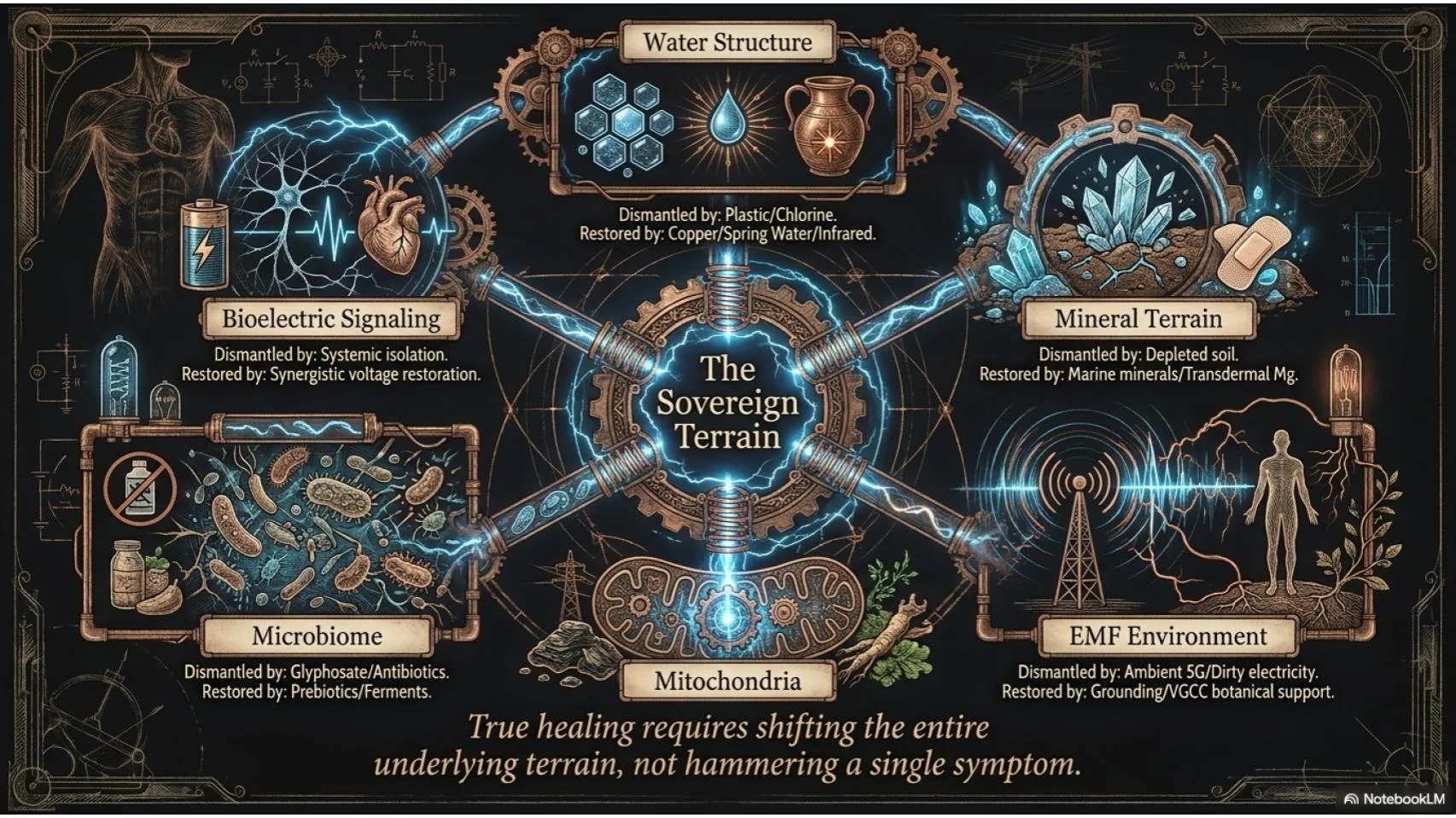
Microplastics are not merely a toxicological problem. They are a terrain architecture problem. They accumulate at precisely the organelles that govern cellular voltage — mitochondria and lysosomes — and disrupt the quality-control mechanisms that determine whether a cell runs at full capacity or degrades into chronic dysfunction. The CLEAR Protocol does not target plastic particles as foreign invaders. It rebuilds the terrain conditions under which the body's own clearance machinery can operate.
This is the Sovereign Health framework applied to the most pervasive environmental contaminant of the 21st century: not filtration, but restoration. Not avoidance alone, but active cellular excretion. The ancient traditions did not know about polyethylene. But every system documented in this archive — Ayurvedic Ama clearance, the Maasai purge-first protocol, Hildegard's bile-stimulating bitter herbs — was designed to remove what the body cannot process on its own. The mechanism is the same. Only the substrate has changed.